Each set is a complete prompt. Copy it, or open it in the studio with the model, aspect ratio and resolution it was written for.
Flip Phone Selfie Flash
A selfie with the arm in frame and a slightly low angle looks most like a front camera of that era.
Nano Banana 2image → image9:16 · 2K
Reference photos: One front-facing selfie; a phone selfie is best because it already carries front-camera distortion.
Edit the reference photo into a 2004 flip-phone front-camera selfie. Keep the exact facial features, face shape, eyebrows and eye spacing of the person in the reference image; only styling and camera look change. Pose: arm extended toward the camera so the upper arm enters the frame from the lower corner, slight upward angle from below eye level, chin tilted up a little. Styling: narrow rectangular sunglasses worn low on the nose, thin silver necklace, glossy lip balm, hair straight with a side part and two thin face-framing strands. Look: direct on-camera flash, flat frontal light, blown highlights on the forehead and nose, cool blue colour cast over the whole frame, slight red-eye glow, visible sensor noise in the shadows, over-sharpened jpeg edges, dynamic range clipped so the background is almost black. Background: a dim bedroom wall with a poster corner and a beaded curtain edge. Framing: selfie distance, head fills the upper two thirds, vertical 9:16. Not a modern phone photo, no HDR, no portrait-mode bokeh.
Negative prompt
modern smartphone quality, HDR, bokeh, natural window light, professional retouching, plastic skin, extra fingers, watermarks
Reference only — the image models available here do not take a separate negative prompt, so this list is guidance for editing the prompt above.
Why this works: The most general entry. If the arm proportions look wrong, delete the arm sentence and keep only the upward angle; the image still holds up.
Digicam Party Flash
Night or indoor group shots that need hard flash and cool pale skin.
GPT Image 2.5 Flareimage → image4:5 · 2K
Reference photos: One half-body or chest-up portrait; crop a group photo down to the main subject so that multiple faces do not affect each other.
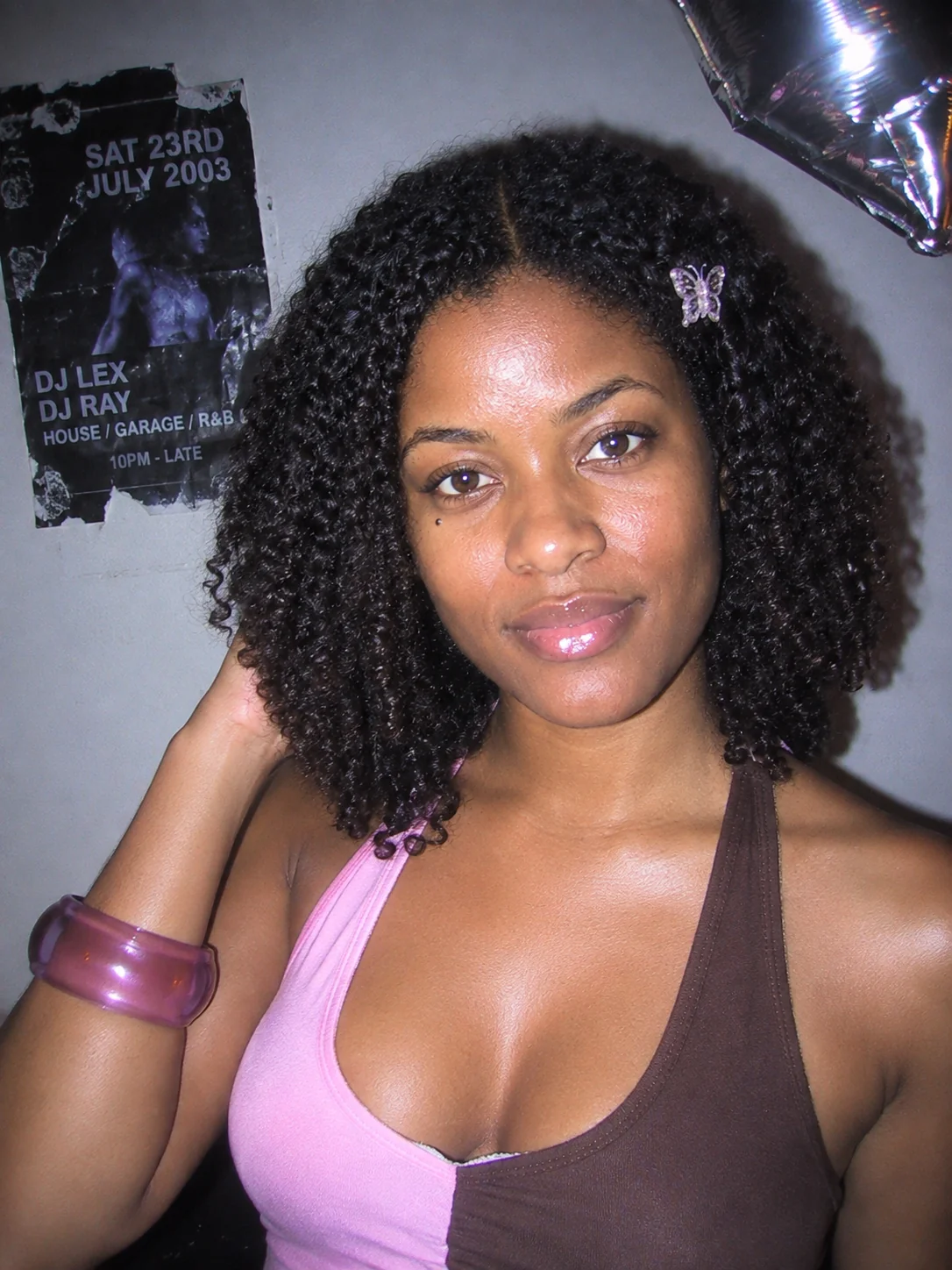
Turn the person in the reference image into a 2003 party snapshot taken on a compact digital camera with the built-in flash. Preserve identity exactly: same facial features, face shape and eye colour as the reference. Styling: two-tone going-out top, chunky plastic bangle, frosted lip gloss, hair with a centre part and a small butterfly clip. Light: harsh direct on-camera flash, hard circular shadow of the subject on the wall behind, hot specular highlights on the forehead and cheekbones, cool white balance with a slight magenta shift on skin, deep clipped blacks in the corners. Camera: 2 megapixel compact at 35mm equivalent, f/2.8, flash on, mild barrel distortion, jpeg compression blocks visible in the smooth wall, red-eye reduction artefact. Background: a nightclub wall with a torn flyer and a piece of silver balloon. Framing: chest up, subject slightly right of centre. Not a studio portrait, no soft fill light, no modern smartphone look.
Negative prompt
soft studio light, natural light, HDR, smooth gradients, high-end camera, professional colour grade, text, logos
Reference only — the image models available here do not take a separate negative prompt, so this list is guidance for editing the prompt above.
Why this works: Indoor party scenes match best. If the skin comes out too blue, change 'cool white balance' to 'slightly warm indoor white balance'.
Lost Photo CD Scan Frame
Use when you want the full 2005 package: compression artifacts, red eye and a date stamp.
Nano Banana 2image → image1:1 · 1K
Reference photos: Any everyday photo with a casual composition will do; the more ordinary the source, the more natural it looks as a recovered old digital frame.
Reinterpret the reference photo as a low-resolution frame recovered from a 2005 photo CD. Keep the person's exact facial identity and expression; the treatment should look like a scan of a compressed digital file rather than a new photo. Styling stays simple: plain tank top, thin hairband, small stud earrings. Camera look: 640 by 480 pixel scan, heavy jpeg blocking around edges, visible chroma noise in shadows, mild motion smear on one arm, blown flash hotspot in the centre of the frame, date stamp burned in the bottom right corner reading 08 14 2005 in orange digits. Colour: washed out with a green-cyan cast in the midtones, slight fading towards the corners. Background: an ordinary kitchen with a fridge magnet and a hanging towel, out of focus by flash falloff. Square 1:1 framing with the subject slightly off centre, as if the file was cropped badly. No modern sharpening, no beauty retouching.
Negative prompt
high resolution, clean edges, modern sharpening, beauty retouch, HDR, bokeh, extra text besides the date stamp
Reference only — the image models available here do not take a separate negative prompt, so this list is guidance for editing the prompt above.
Why this works: This tier is a share image rather than a portrait and deliberately sacrifices sharpness. If the date digits come out mushy, shorten the date to a purely graphic string or delete the date sentence.
Y2K Fashion Cover (No Reference)
Page sample images and stress-testing of generation settings.
Nano Banana 2 Litetext → image3:4 · 1K
A 2002 teen magazine cover photo, shot on a compact digital camera with direct on-camera flash. An adult woman with straight centre-parted hair, thin face-framing strands, frosted pink lip gloss and narrow rectangular sunglasses worn low. Clothing: low-rise denim with a cropped two-tone top, small butterfly hair clip, one silver bangle. Light: harsh frontal flash, hot highlights on the cheekbones, hard shadow on a lavender painted wall behind, cool blue colour cast, visible sensor noise, slightly over-sharpened edges. Extras: a crescent of a silver balloon and a torn flyer on the wall. Composition: three-quarter body, subject centred, vertical framing. Add a clean cover masthead in bold rounded sans serif reading POP! and one short cover line at the lower left reading SUMMER MIX. All other text-free. Printed with light jpeg artefacts, not a modern high-resolution photo.
Why this works: The text-only sample tier and the cheapest one. If the masthead text comes out misspelled, delete the masthead sentence and keep only the photo.